Quality, Specifications & Traceability
How Zambrew evaluates Ugandan green coffee before it is shipped, what the specification fields on our product pages mean, what we can genuinely trace, and the standard behind it all: claims backed by records, not adjectives.
How Every Lot Is Checked
Physical inspection by our ground team
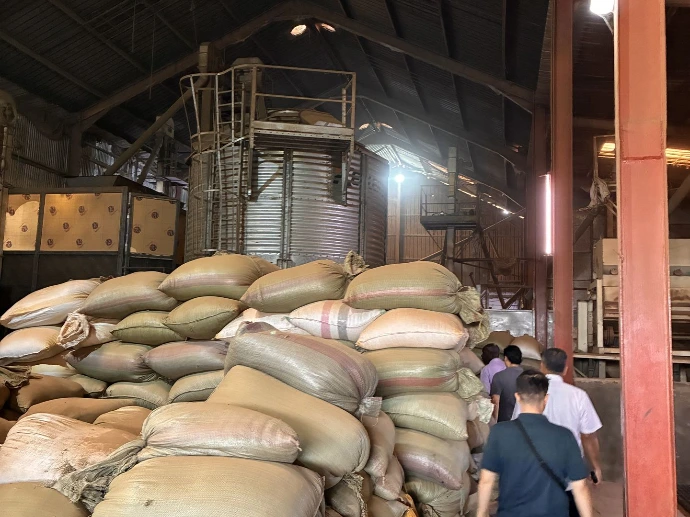
Our own team in Uganda physically inspects every lot before purchase. We measure moisture content, bag weight, defect rate, crop age, and other visual indicators.
Pre-shipment and trade controls
Lots are approved by the UCDA in Uganda against a rigorous standard set out by the Ugandan government. Furthermore, lots are prepared for UK bound import regulation and documented accordingly.
Cupping and evaluation
We do not cup or score lots ourselves, cupping is one of the things we do not measure, and product pages carry no cup scores. Sensory evaluation is left to you. We can provide you with a general profile of Ugandan robusta but the best judge would be you.
Reading a Zambrew Specification
| Field | What it tells you |
|---|---|
| Crop year | The harvest period of the lot (e.g. Q4 2025) a key freshness indicator for green coffee. |
| Process | How the cherry was handled after picking (e.g. natural sun-dried in cherry), which shapes body and sweetness. |
| Preparation / grade | The physical sort: Robusta screen sizes (bean size, e.g. Screen 18) or Arabica grade terms (e.g. Drugar Grade AA). |
| Moisture | Water content of the green beans; our current lots sit between 10% and 12%, a range consistent with stable storage. |
| Defects | The proportion of imperfect beans; Normally fewer than 7%-8% non-primary defects. |
Lot specific information can be found on the coffee page.
Shipping and Consistency
Every lot is inspected and approved in Uganda before it is loaded into a full container for export through the port of Mombasa. Each container is shipped as a single consignment, so the coffee you cup as a sample is the coffee in your container.
On FOB terms, responsibility passes to you once the container is on board at Mombasa. On DDP terms, we remain responsible until the container is delivered to your UK warehouse. See how DDP and FOB work.
How We Define Traceability
Traceability is a level, not a yes/no claim. Zambrew describes each lot at one of the following levels, stated on its product page.
Country level
Verified Ugandan origin.
Region level
A named growing area (e.g. Mount Elgon, Rwenzori, central Robusta belt).
Station / co-operative
A named washing station, mill or co-op.
Producer group / farm
Named producers, where records and permission exist.
Our Sourcing Relationships
Zambrew's own team sources in Uganda, working with more than 50 partner farms and co-operatives to secure quality throughout the year.
When we describe our sourcing as direct, this is what we mean: our people select and buy coffee in Uganda through these relationships, rather than purchasing anonymously from a trading desk.
How Information Reaches You
Lot information recorded at origin — region, partner, process and crop period — flows into the product page and the documents that accompany your purchase. Where a field was not recorded, the product page says so.
Our Claims Policy
We do not use terms such as "ethical", "sustainable" or "fair" as unsupported labels. Any social or environmental claim on this site must be lot-specific, defined and evidenced and if we cannot substantiate a claim, we do not make it. Where traceability stops at a defined level (for example, coffee blended at a co-operative), we say so transparently.
Deforestation Regulation: EUDR and the UK
The EU Deforestation Regulation (EUDR) does not apply in the UK. A comparable UK regulation is currently in review and expected in 2027 and we are preparing for it now, building the origin records and chain-of-custody information our lots will need, so that our buyers are ready when it arrives. If you sell into the EU and need EUDR-relevant origin information for a specific lot, ask us and we will state plainly what we can and cannot provide.
Quality FAQs
The coffee in your container is guaranteed to match the sample or approved description listed on the product page.
No. We do not cup or score lots, and product pages mark cup data as not measured. Cupping and evaluation are left to you: samples are free, so you can score every lot on your own bench before ordering.
Moisture outside a safe range risks fading, condensation damage or mould in storage. 10% - 12% is a widely accepted stable range for green coffee though sometimes +- 2% is generally accepted.
Each product page states its traceability level from verified Ugandan origin up to named producers where records and permission exist. Buyers preparing for due diligence can ask us what information is available for a specific lot.
See also: current coffees and how to buy.
Judge the Coffee on Your Own Bench
Every specification is backed by a free sample, and every claim by a record cup it before you commit.