
Overview
Almost everyone has held a roasted coffee bean but far fewer have seen the original; green coffee. This is the raw unroasted seed of the coffee fruit, dried and ready for shipment but not yet roasted. It’s pale dense and faintly grassy smelling and on its own it tastes almost nothing like coffee.
This is where the whole story begins. Every espresso, every cup of filter, every tin on a supermarket shelf traces back to a green bean that was grown, picked, processed and traded long before anyone applied heat. This post sets out what green coffee actually is, how it differs from the roasted bean most people know, and why it is bought and sold as a commodity in its own right. The rest of the Foundations series builds from here.
What green coffee actually is
A coffee bean isn’t actually a bean, it’s the seed of a small fruit typically called a cherry. This cherry grows on a tree belonging to the Coffea genus. Most cherries contain two seeds, positioned flat sides together. After removing the fruit and its inner layers and drying the seed, what’s left is green coffee.
The colour does the naming. Depending on the variety and how it was processed, the dried seed ranges from bluish jade to a soft yellow-green. That colour fades as the coffee ages and disappears completely in the roaster, which is one reason "green" is a useful label for the trade as it describes the bean at the exact point where it is stable, storable and ready to travel.
Pick up a green bean and it feels nothing like the roasted version. It is hard enough to be tricky to bite, dense in the hand, and slightly waxy, and it smells closer to fresh hay or raw peas than to anything in a café. That rawness is the whole point. The tastes we think of as coffee do not yet exist in the bean; they are built later by heat. What the green seed carries instead is potential, in the form of sugars, acids, proteins and aromatic precursors that roasting will go on to convert into the flavour in the cup. A small separate industry even sells green coffee as an extract or supplement for various benefits including weight loss, brewed or processed without roasting, though that is a world away from the drink most people mean by the word. source on weight loss
Green coffee is also where quality is locked in, a roaster can ruin good green coffee, but no amount of skill at the roaster can add flavour that the green bean never had. Everything that happens on the farm and at the mill is, in effect, an investment in the green seed. The roast simply unlocks it.
Green versus roasted: what actually changes
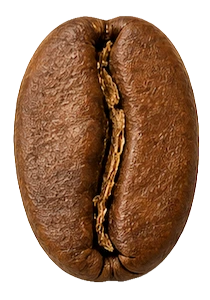
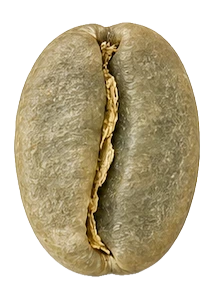
The Roasting Process
Slide to explore the visual transformation from raw, green unroasted coffee to our rich, dark signature roast.
The Roasting Process
Slide to explore the visual transformation from raw, green unroasted coffee to our rich, dark signature roast.
Put a green bean and a roasted bean side by side and the differences look obvious. One is small, hard and pale; the other is larger, browner and brittle. The interesting part is what causes that change.
The biggest factor is water. Green coffee is usually dried to somewhere around 10% to 12% moisture before it is exported, a level low enough to keep it stable in storage but high enough to keep it alive. Roasting drives most of that water off in the first minutes, then pushes the bean through a series of chemical reactions that build colour, aroma and the hundreds of flavour compounds we associate with coffee. Royal Coffee publishes and excellent source for understanding roast yield and loss.
Roasted coffee weighs noticeably less than green coffee because so much water and gas escape during the roasting process. A typical batch loses around 11% to 24% of its weight. This loss is greater for lighter roasts and less for darker roasts. Furthermore, the bean swells and becomes brittle as steam expands inside it, explaining why roasted coffee crushes easily while green coffee doesn’t.
The other practical difference is shelf life. Roasted coffee starts to stale within weeks as it loses aromatics and reacts with oxygen. Green coffee, kept cool and dry, holds its quality for many months and can be shipped across the world without spoiling. That single fact shapes the entire trade, and it is the reason coffee crosses oceans green rather than roasted.
Why green coffee is traded on its own
If roasted coffee goes stale so quickly, the logic of the trade falls into place. Coffee is grown in a band of countries near the equator and drunk mostly in Europe, North America and East Asia, though this dynamic is changing. Sending it roasted would mean shipping a fragile, fast-ageing product thousands of miles. Sending it green means shipping a stable raw material that the buyer can roast fresh, close to the customer, whenever they choose.
So green coffee, unroasted, is the commodity actually traded globally. It’s nomrally bought by the sack, shipped in containers, stored in bonded warehouses and priced against international benchmarks. Most of the world’s arabica trades against the “C” price, a reference figure set on the ICE futures exchange, while robusta has its own separate contracton the London stock market. These benchmarks provide a shared starting point for buyers and sellers, with quality origin and certification adding or subtracting value.
The scale is easy to underestimate. In the 2024/25 season the world produced roughly 174 million 60-kilogram bags of green coffee, and output for 2025/26 is forecast to reach a record of close to 179 million bags. see the USDA report here. Coffee sits among the most heavily traded agricultural products on earth, and almost all of that volume moves as green beans. When people talk about the "coffee market", the price of "coffee", or a shortage or glut, they are nearly always talking about green coffee.
Because it is a commodity, its price fluctuates, sometimes dramatically. In major producing countries factors like weather, shipping costs, currency changes and harvest size influence the benchmark, causing it to rise and fall. These fluctuations ripple through the supply chain, ultimately reaching the farmer and the coffee drinkers. For instance, a frost or drought in a key origin can elevate global prices, contributing to coffee’s ability to remain affordable for years before experiencing a sudden surge. Quality and origin sit on top of the benchmark; a distinctive lot from a sought-after region sells at a premium, often called a differential, while ordinary commodity-grade coffee tracks close to the reference figure. We’ll revisit this pricing mechanism as the series reaches the market.
Where green coffee sits in the bigger picture
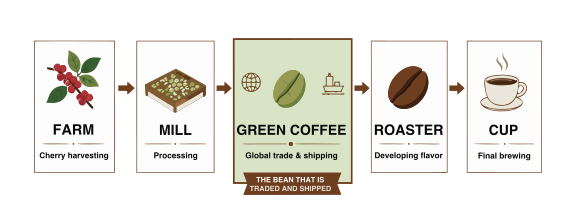
Green coffee is a midpoint, not a starting line. By the time a bean is green it has already been grown, harvested and processed, and it still has roasting, grinding and brewing ahead of it. Treating it as its own subject is useful precisely because it is the hinge between the farm and the cup. Producers are judged on the green coffee they deliver. Roasters and traders build their businesses on the green coffee they buy.
It is also why the months a bean spends as green coffee are not dead time. A coffee that was grown and processed beautifully can still be dulled by damp storage or a long, hot voyage, so this stretch of the journey is a window in which quality is either held or lost. Good green coffee is, in that sense, both a finished product for the people who grow it and a raw ingredient for the people who roast it, which is exactly why it deserves a name and a definition of its own.
Frequently answered questions (FAQ)
Yes. Green coffee is the dried, unroasted seed of the coffee fruit. It is the same bean you drink, before any heat has been applied.
No, but you can steep it, and green coffee extract is sold as a supplement, but it does not taste like the coffee most people expect. The flavours we associate with coffee are created during roasting, so an unroasted bean brews into something grassy and sharp rather than rich.
Roasted coffee stales within weeks, while green coffee stays stable for many months. Shipping it green lets it travel long distances and be roasted fresh near the customer.
Yes. Caffeine is largely stable through roasting, so it is already present in the green bean. Roasting changes flavour and weight far more than it changes caffeine.
We maintain rigorous editorial integrity and provide the most accurate information possible. If the details of this article have changed or you would like to make a suggestion please contact us.
Last reviewed: 08/06/2026